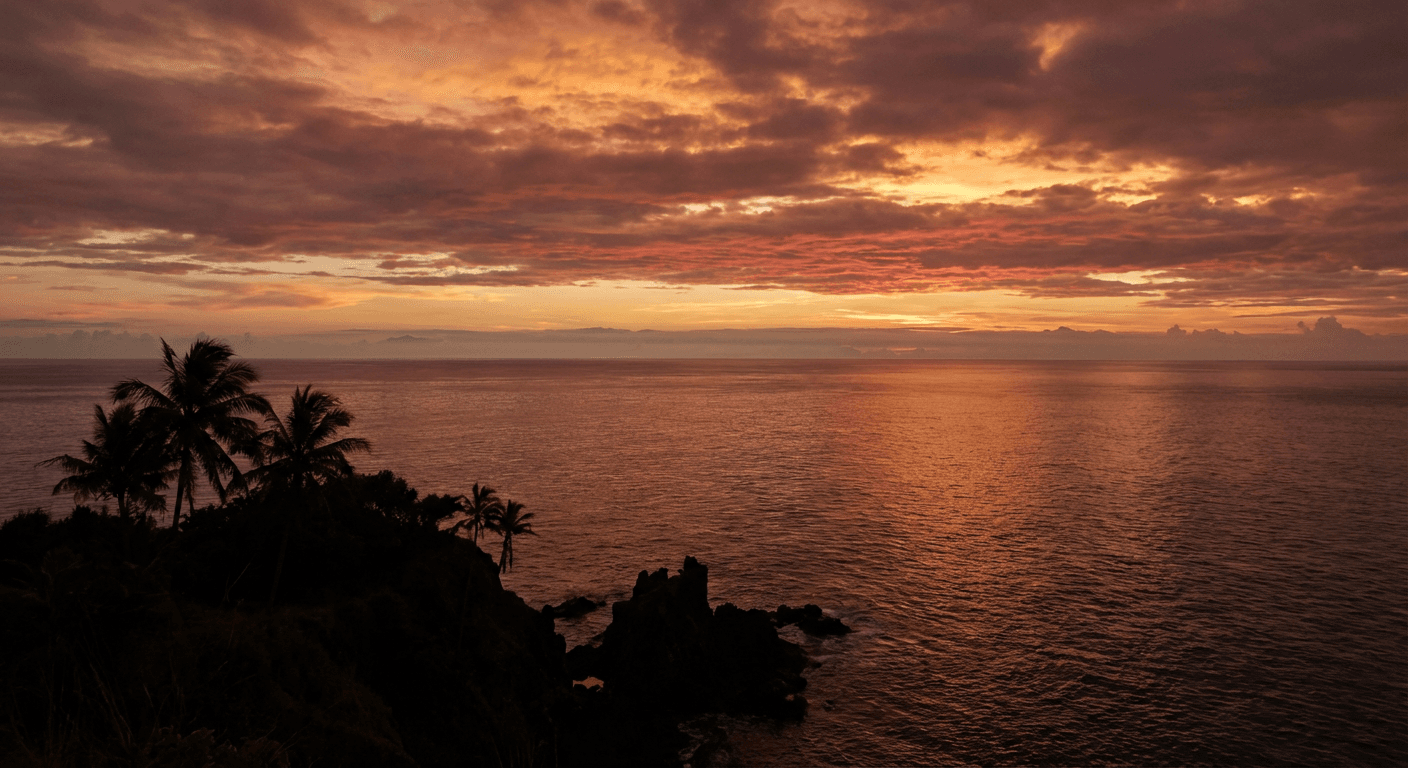
There is a moment, flying east from Bali, when the turquoise shallows give way to deep indigo and the islands below become wilder, less certain. The resorts thin out. The cruise ships vanish. And then, rising from the Savu Sea like a fragment of another century, Sumba appears.
This is not the Indonesia of overtourism and algorithm-friendly sunsets. Sumba is something rarer — a place that has resisted the gravitational pull of mass travel, not through inaccessibility alone, but through a quiet, ancestral stubbornness. The island does not perform for visitors. It simply exists, as it has for centuries, on its own magnificent terms.
A Landscape That Defies Expectation
Sumba confounds anyone who thinks they know what Indonesia looks like. Forget the volcanic drama of Java or the stacked rice terraces of Bali. Here, the terrain is closer to the African savannah — vast golden grasslands rolling toward limestone cliffs that drop hundreds of feet into the Indian Ocean. Lone horses graze on hilltops. Sandalwood trees scent the dry-season air.
And then there is the water. Weekuri Lagoon, a saltwater pool fed by underground channels, sits impossibly still between walls of rough karst rock — the kind of place that feels engineered by a set designer with an unlimited budget. Tanggedu Waterfall cascades in tiers through a canyon of amber stone, accessible only by a trek through forest and riverbed. Nihiwatu Beach, once declared the world's best by Travel + Leisure, breaks with a left-hander that surfers speak of in reverent tones.
But Sumba's most arresting features may be the ones that predate tourism entirely. Enormous megalithic tombs — flat stone slabs weighing several tonnes, dragged by hand from distant quarries — dot the hillsides. They are not relics. New ones are still carved and erected today, testament to a spiritual tradition that has never been interrupted.
A Living Culture, Not a Museum
Sumba is one of the last places in Indonesia where animism is not a historical footnote but a living practice. The Marapu belief system governs daily life in many villages — an intricate cosmology of ancestral spirits, ritual obligation, and the sacred balance between the visible and invisible worlds. Clan houses with their iconic peaked roofs, soaring thirty feet or more, are built according to precise spiritual geometry. The highest point of the roof shelters sacred heirlooms and offerings to the ancestors.
The island's textile tradition is equally formidable. Sumbanese ikat — fabric woven from threads that are painstakingly tie-dyed before being placed on the loom — is among the most complex and coveted in Southeast Asia. A single ceremonial cloth can take months to complete. The motifs are not decorative; they encode genealogy, social rank, and spiritual protection. To watch a weaver work in the village of Prailiu or Rende is to witness something closer to manuscript illumination than craft.
Then there is the matter of horses. Sumba has been called the island of horses, and the comparison is not casual. Small, hardy Sumbanese horses are integral to daily life, transport, and — most spectacularly — to Pasola, the annual ritual jousting festival held each February and March. Riders hurl wooden spears at one another from horseback in a ceremony meant to balance the spiritual forces governing the harvest. Blood must be drawn; it is considered an offering to the earth. Pasola is not staged for tourists. It is a negotiation between a community and its gods, conducted at full gallop.
The Case for Stillness
What sets Sumba apart in the current landscape of luxury travel is not what it offers but what it withholds. There is no nightlife. No shopping district. No influencer infrastructure. The island's appeal is fundamentally anti-spectacle — it asks you to slow down, to sit with silence, to find grandeur in a hand-woven textile or the geometry of a megalithic tomb rather than in curated excess.
This is precisely why we chose Sumba for CANDELA.
We were not looking for the next destination. We were looking for a place where destination itself becomes secondary to presence — where the architecture of a resort could recede and let the landscape speak. Sumba's south coast, where CANDELA is taking shape, delivers this with an almost theatrical generosity: sweeping ocean views, undeveloped coastline, the sound of nothing but wind and surf and, occasionally, the distant bells of grazing livestock.
Our twenty private pool villas are designed not to compete with this setting but to frame it. Every sight line, every material choice, every considered absence — no television in the bedroom, no muzak at the pool — serves a single ambition: to let Sumba be Sumba. Privacy is not a luxury add-on here; it is the founding principle. The island's natural remoteness does what no velvet rope ever could.
An Invitation, Not an Advertisement
Sumba will not remain unknown forever. The first wave of boutique properties has already arrived, and direct flights from Bali have made the journey a matter of hours rather than days. The window of genuine discovery is narrowing.
CANDELA is being built for the travellers who understand this — who want to be among the first rather than the many, who value authenticity over amenity count, and who recognise that the most extraordinary places on earth are often the ones that never asked to be found.
We are now welcoming expressions of interest for our founding guest list — a small circle of early supporters who will shape the resort's first chapter and enjoy preferential rates and priority access when we open our doors.
If Sumba calls to you the way it called to us, we would be honoured to welcome you.
Comments
Be the first to share your thoughts.